Setting up the Yoshida-Uemori material model in JSTAMP from tension test data
SPC270 steel, 0.9 mm: a motorcycle fuel tank formed by sheet hydroforming.
- Part
- Motorcycle fuel tank, sheet hydroforming
- Material
- SPC270 mild steel, 0.9 mm
- Software
- JSTAMP
- Task
- Calibrate the Yoshida-Uemori model
- Verification
- Tension-compression test data and the formed part
Summary
Predicting the shape of a formed part depends on a material model that captures the Bauschinger effect, which needs cyclic test data. This study shows that the Yoshida-Uemori (YU) parameters of SPC270 steel can be obtained from a uniaxial tension test in the rolling direction (RD) with the MatPara software, and that the resulting cyclic curve agrees with measured tension-compression data. Used in JSTAMP to simulate a hydroformed motorcycle fuel tank, the combined isotropic-kinematic hardening model predicted the part more accurately than the isotropic hardening model.
The challenge: modeling the Bauschinger effect
When a sheet is bent and unbent while flowing over a die radius, its yield stress after the reversal is lower than before. An isotropic hardening model cannot represent this, and shape and springback predictions suffer. The Yoshida-Uemori model can, using two surfaces: a yield surface that moves inside a larger bounding surface.
The parameters of such a model are usually identified from cyclic data such as a tension-compression (T-C) test, which is harder to run than a standard tension test. The question in this study: can the parameters be obtained from tension data that most laboratories already have?
Method
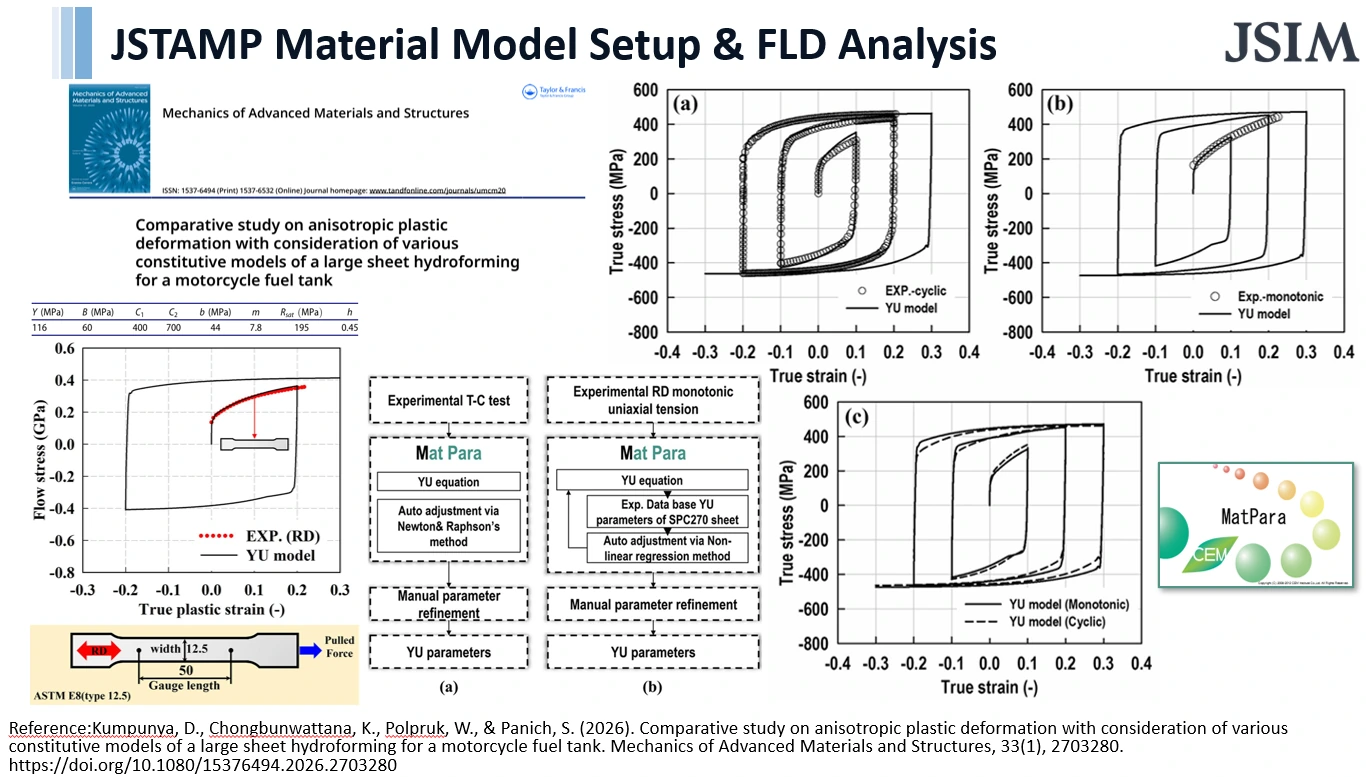
- Route 1, from a T-C test: enter the tension-compression data in MatPara, adjust the parameters automatically with the Newton-Raphson method, then refine them manually.
- Route 2, from RD tension only: apply the YU equation to the RD flow stress curve and a database of SPC270 parameters, adjust by non-linear regression, then refine manually.
- Compare the cyclic curves predicted by both routes with the measured T-C data.
- Use the calibrated model in JSTAMP to simulate the hydroforming of the fuel tank, and compare the result with the formed part: surface height and thickness at 22 points.
The calibrated YU model was combined with three anisotropic yield criteria (Hill’48, Yld2000-2d and Yoshida2013) and two hybrid hardening laws, and compared with the same models using isotropic hardening.
Material data and calibrated parameters
| Material | SPC270 mild steel |
|---|---|
| Sheet thickness | 0.9 mm |
| Yield strength (0.2%, RD) | 135.3 MPa |
| Tensile strength (RD) | 287.2 MPa |
| r-value (RD / DD / TD) | 2.936 / 2.077 / 2.293 |
| Yoshida-Uemori parameters | Y = 116 MPa, B = 60 MPa, C₁ = 400, C₂ = 700, b = 44 MPa, m = 7.8, Rsat = 195 MPa, h = 0.45 |
These are the values published in the cited article, calibrated from the RD tension flow stress curve.
Results
Material model. The cyclic curve predicted by the YU model with parameters calibrated in this way agrees closely with the measured tension-compression data, with a slight deviation. The curves predicted from the two routes differ slightly in the back stress region, which the authors judge acceptable. They conclude that parameters obtained from tension data can replace experimental cyclic data.
Fuel tank. The hydroforming of a 650 × 825 mm blank, with oil pressure of up to 30 MPa, was simulated in JSTAMP with twelve combinations of material models and compared with the formed part. The table shows the share of the part whose surface height is within 1 mm of the measured profile for the best model of each type. The combined isotropic-kinematic model also predicted thickness more closely than the isotropic one.
| Best model of each type | Share of the part within 1 mm |
|---|---|
| Isotropic hardening (Yld2000-2d, hybrid Swift-Hockett-Sherby) | 73.13% |
| Combined isotropic-kinematic hardening (Yoshida2013, hybrid Swift-Hockett-Sherby) | 82.3% |
Takeaway
Yoshida-Uemori parameters obtained from RD tension data reproduced the cyclic behavior of SPC270 steel, and adding kinematic hardening to the JSTAMP model improved the prediction of the formed fuel tank. Less material testing is needed to set up a model that captures the Bauschinger effect.
Source
Kumpunya, D., Chongbunwattana, K., Polpruk, W., & Panich, S. (2026). Comparative study on anisotropic plastic deformation with consideration of various constitutive models of a large sheet hydroforming for a motorcycle fuel tank. Mechanics of Advanced Materials and Structures, 33(1), 2703280. https://doi.org/10.1080/15376494.2026.2703280. The first author is affiliated with JSIM Co., Ltd. and King Mongkut’s University of Technology North Bangkok. Figures are from the article, as shown on a JSIM presentation slide.
Want to set up a material model for your sheet?
Tell us the material and the problem, and a JSIM engineer will suggest how to set it up in JSTAMP. See also JSTAMP.