Springback compensation of a JSC980Y pillar part with JSTAMP/NV
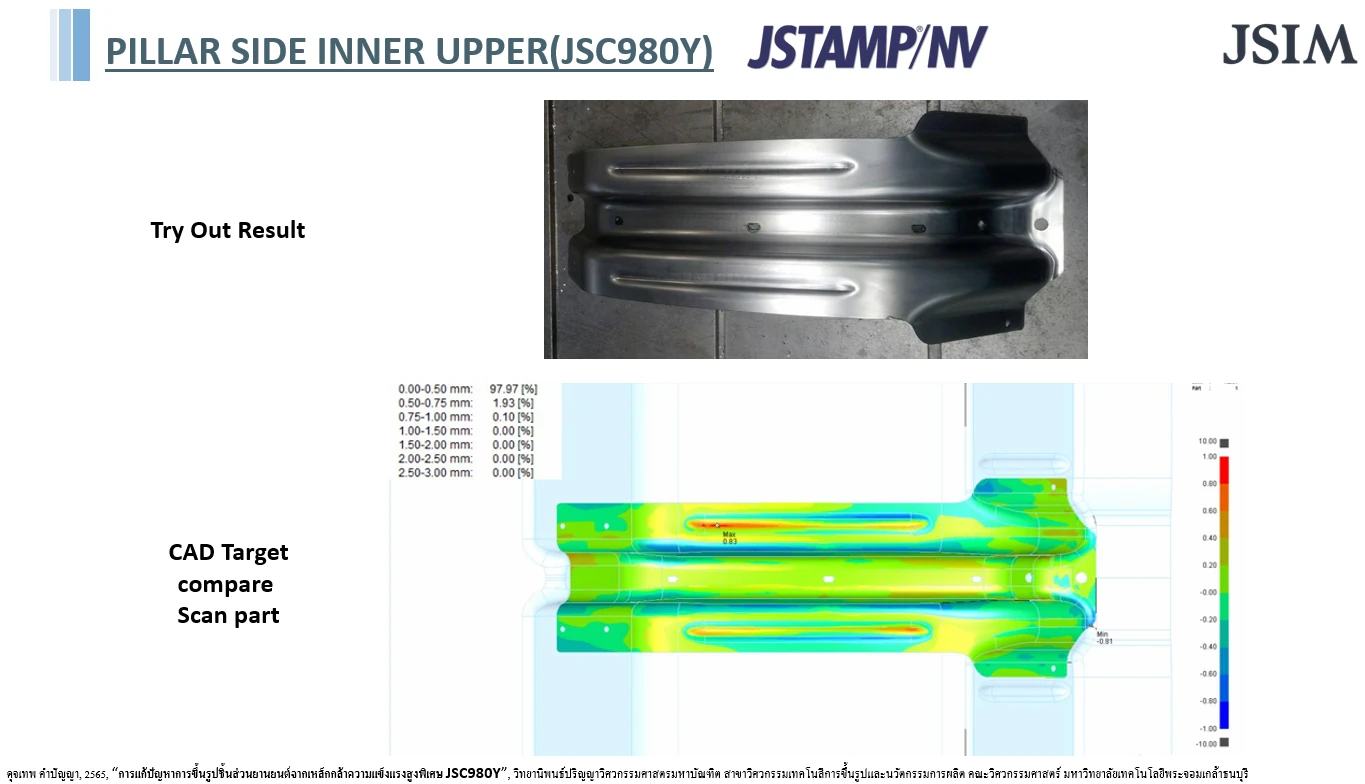
After compensation, 97.97% of the scanned tryout part is within 0.50 mm of the CAD target.
- Part
- Pillar Side Inner Upper
- Material
- JSC980Y, 1.40 mm
- Software
- JSTAMP/NV
- Task
- Predict and compensate springback
- Verification
- Tryout part, 3D scan compared with CAD
Summary
The Pillar Side Inner Upper is a structural body part formed from JSC980Y, an ultra-high-strength steel in the 980 MPa class. Before compensation, the simulation showed that only 18.42% of the part stayed within 0.50 mm of the CAD shape, while 67.06% deviated by 1.00 mm or more. After the die shape was compensated using JSTAMP/NV, the simulation showed 98.38% of the part within 0.50 mm, and the scanned tryout part confirmed it with 97.97%.
The challenge: springback in 980 MPa steel
Steel of this strength class is used for pillars, reinforcements and impact members because it allows thinner, lighter parts without giving up strength. It is also harder to form than conventional steel:
- High springback. The stronger the steel, the more the part springs back after leaving the die, so the shape drifts away from the CAD model.
- Lower formability. Elongation is lower, so cracking and edge splits are a bigger risk, especially in stretched areas and flanges.
- Higher forming force and die wear. Trial and error at the press costs more than with conventional steel.
- Dimensional variation. Warping and twisting can stop the part from fitting its mating parts.
When springback is hard to judge by experience and every die correction is expensive, it is more efficient to see the springback on screen and compensate the die before production.
Method
- Simulate forming and springback with JSTAMP/NV to see where and by how much the part springs back.
- Compensate the die shape according to the simulation result, and check the simulated result after compensation.
- Run a tryout, 3D-scan the part and compare it with the CAD target.
Material data used in the simulation
| Material | JSC980Y |
|---|---|
| Sheet thickness | 1.40 mm |
| Yield stress | 605.8 MPa |
| Tensile strength | 1,132.3 MPa |
| Elastic modulus | 199,490 MPa (variable elastic modulus enabled) |
| Poisson’s ratio | 0.30 |
| Density | 7,850 kg/m³ |
| Mean r-value | 1.38 |
| Material model | Yoshida-Uemori with Hill’48 yield function |
Springback in high-strength steel depends on how the sheet is bent and unbent as it flows over the die radii. The Yoshida-Uemori model captures the Bauschinger effect and the transient hardening and softening that follow a load reversal, and the variable elastic modulus accounts for the drop in elastic modulus as plastic strain accumulates. Models that leave these effects out tend to misjudge the amount of springback. The full model parameters are not published here.
Results
The first figure compares the simulated deviation from CAD before compensation (Original) and after it (Compensate). The color scale covers ±1.00 mm.
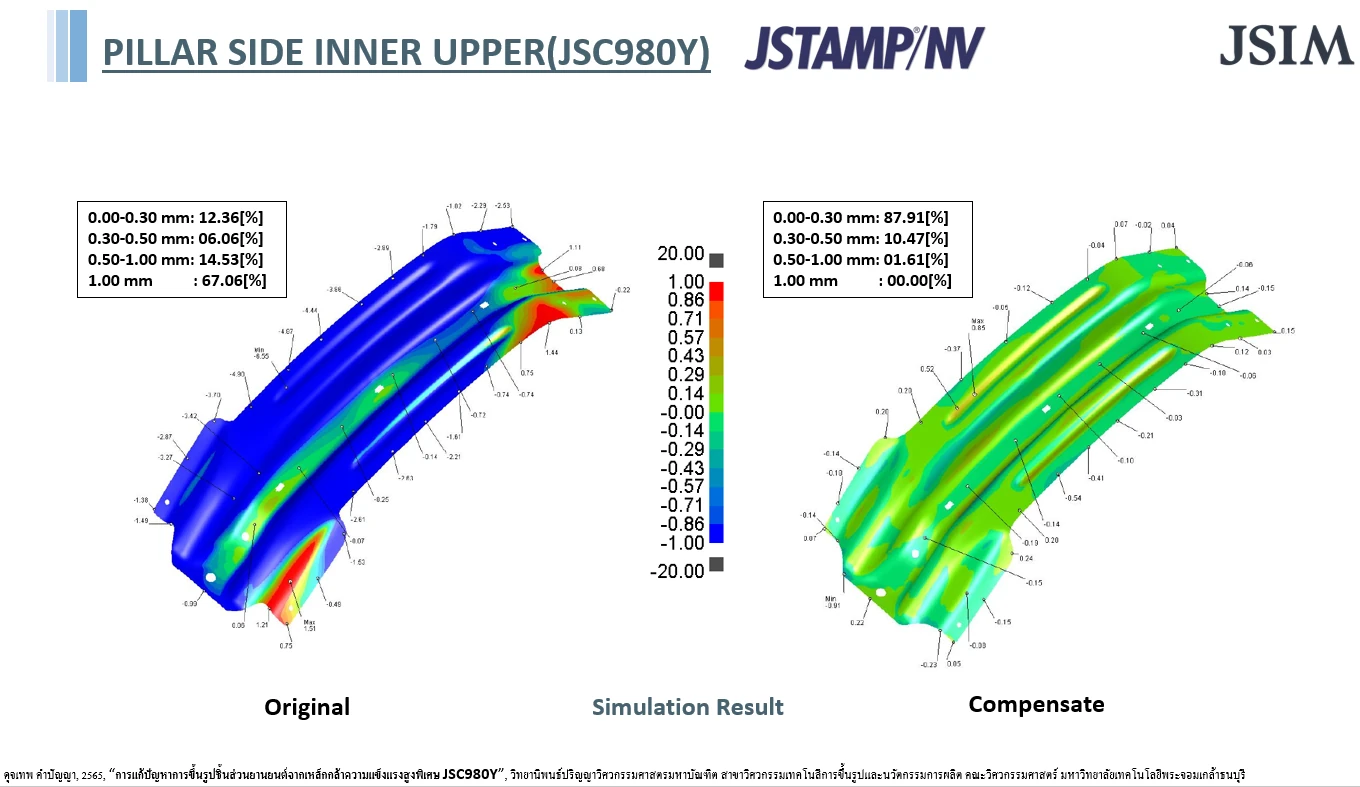
| Deviation from CAD | Original | Compensated |
|---|---|---|
| 0.00–0.30 mm | 12.36% | 87.91% |
| 0.30–0.50 mm | 6.06% | 10.47% |
| 0.50–1.00 mm | 14.53% | 1.61% |
| 1.00 mm or more | 67.06% | 0.00% |
The tryout part was then 3D-scanned and compared with the CAD target. 97.97% of the part is within 0.50 mm, 1.93% is between 0.50 and 0.75 mm, and 0.10% is between 0.75 and 1.00 mm. No area deviates by more than 1.00 mm. The largest deviations on the scan are about +0.83 mm and −0.81 mm.
Takeaway
The simulation after compensation (98.38% within 0.50 mm) and the scanned tryout part (97.97%) agree closely. Simulating springback and compensating the die shape from the result brought a 980 MPa steel part very close to its CAD target.
Source
Kham Panya, K. (2022). Solving the forming problem of an automotive part made of ultra-high-strength steel JSC980Y (in Thai). Master’s thesis in Engineering, Manufacturing Technology and Innovation, Faculty of Engineering, King Mongkut’s University of Technology Thonburi. Result figures: JSIM presentation material.
Have a forming problem like this?
Tell us the part, the material and the problem, and a JSIM engineer will suggest how to analyze it with JSTAMP. See also JSTAMP.